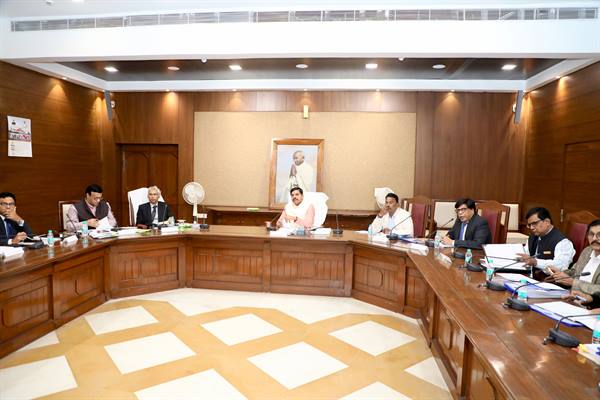
Chief Minister Dr. Mohan Yadav stated that in the past two years, new irrigation capacity has been developed over 7.31 lakh hectares in the state. The irrigation capacity is expected to increase by 8.44 lakh hectares by 2026. The state is working towards the goal of increasing irrigation coverage to 100 lakh hectares. The review of irrigation projects in the state will be carried out using the Prime Minister GatiShakti Portal.
Chief Minister Dr. Yadav reviewed the activities of the Water Resources Department and Narmada Valley Development Department in the Assembly committee hall. He highlighted the approval of inter-state link projects such as Parvati–Kali Sindh and Ken–Betwa, along with the Central Government’s cooperation, as significant achievements. Chief Minister Dr. Yadav directed the implementation of the river-linking project within the state to connect various rivers.
The Water Resources Department informed that surveys and studies have been conducted for the river linking project. Under this project, surveys were conducted in Ujjain district for the Kanha–Gambhir project; in Mandsaur, Neemuch, and Ujjain for the Kalisindh–Chambal project; in Satna district for the Ken and Mandakini rivers; in Seoni and Chhindwara districts for the Shakkar–Pench and Dudhi–Tamia projects; and in Raisen district for the Jamner–Nevan and Nevan–Bina rivers. Implementation of these projects will enable irrigation over a total area of 5.97 lakh hectares, with an estimated cost of Rs 9,870 crore. Thousands of farmers from seven districts will benefit from these schemes.
A technical team was formed on November 13, 2024, to connect the rivers in the state, aiming to manage floods, optimise water use, and ensure adequate water availability in riverbeds. Chief Minister Dr. Yadav directed officials to study the ancient technique used in the construction of the Bhopal lake and develop low-cost, safe reservoir and dam models based on this concept. He also instructed the department to demonstrate the Bhopal model.