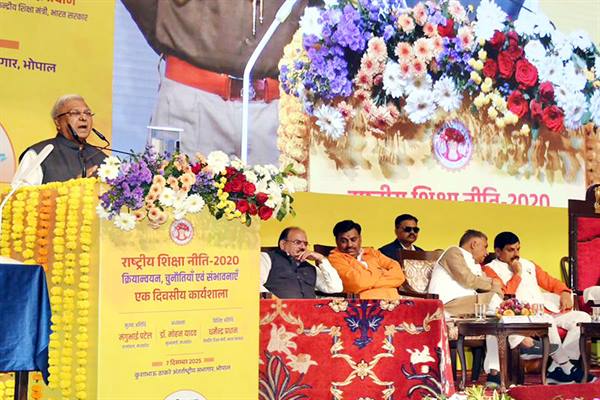
A one-day workshop on ‘National Education Policy 2020: Implementation, Challenges and Opportunities' commenced with the tunes of the national anthem at Kushabhau Thakre Auditorium in the presence of Governor Shri Mangubhai Patel as the chief guest and Chief Minister Dr. Mohan Yadav as chair. Union Education Minister Shri Dharmendra Pradhan, Higher Education Minister Shri Inder Singh Parmar, School Education Minister Shri Uday Pratap Singh, and Minister of State (Independent Charge) for Minority and Backwards Classes Welfare Smt. Krishna Gaur were also present.
Governor Shri Mangubhai Patel’s Address
Governor Shri Patel said that Madhya Pradesh must make efforts with clear direction, defined goals and coordinated work culture to become a leading state in educational transformation. The National Education Policy-2020 is a symbol of the confidence that youth hold in transforming society and the nation. It is a visionary plan to give a new direction to India’s future, rooted in the principle of holistic development. He appreciated the collective initiative to deliberate on the challenges and opportunities of implementing the NEP in the context of Madhya Pradesh’s unique circumstances.
Governor Shri Patel said that the policy’s provisions, such as the Integrated Undergraduate Program, Multiple Entry and Exit System, Academic Bank of Credits, and research-oriented environment, offer opportunities to make higher education flexible, modern, and globally competitive. For this, the state’s higher education institutions must strengthen innovation, quality faculty development, digital infrastructure, and industry–academia partnerships in a time-bound manner. He emphasised the need to promote foundational literacy and numeracy through mother-tongue-based experiential learning, improved teacher training, modern technology, and innovative pedagogies.
Governor Shri Patel said that to prepare students for the 21st century, it is important to build skills through artificial intelligence, digital literacy, and new dimensions of self-learning—requiring ‘out-of-the-box’ thinking. He stated that successful implementation of the policy is not merely an administrative exercise, but a collective national effort. He cited Gujarat’s Doodh Sanjeevani scheme, stating that providing milk to students improved both nutrition levels and school attendance. He said that sending children to school does not absolve parents of responsibility—parents also play a crucial role in children’s overall development.