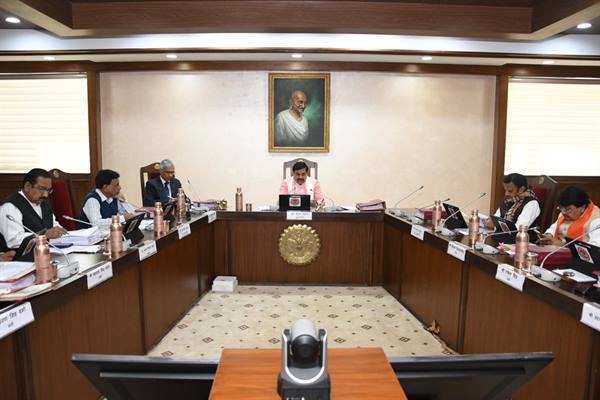
Chief Minister Dr. Mohan Yadav further expanding the e-governance system in the state arrived at the Council of Ministers meeting today carrying a tablet. It is noteworthy that in the Cabinet meeting held on January 6, on the initiative of Chief Minister Dr. Yadav, tablets were provided to ministers with the objective of initiating the e-Cabinet process in the state. A presentation on the e-tablet application was also made before the Council of Ministers. Chief Minister Dr. Yadav stated that this initiative will help adopt paperless work processes, save time, and ensure transparency.
Eligible beneficiaries to receive benefits of 91 schemes/services of 16 departments under the Sankalp Se Samadhan Campaign
Before the Cabinet meeting, in his address, Chief Minister Dr. Yadav said that the “Sankalp Se Samadhan Campaign” was launched on January 12, on the occasion of Youth Day, the birth anniversary of Swami Vivekananda. The campaign will be conducted in four phases till March 31. Under this campaign, eligible beneficiaries will be provided benefits of various government schemes and services. A total of 91 schemes/services of 16 departments are included, and the campaign will be conducted simultaneously in both urban and rural areas.
In the First Phase from January 12 to February 15, 2026– will be received. In the Second Phase February 16 to March 16 – camps will be organised to resolve applications received in the first phase and pending applications. From March 16 to March 26, 2026in the third phase Block-level camps will be organised to resolve unresolved applications and complaints. In the Fourth Phase from March 26 to March 31, 2026District-level camps will be organised for resolution of applications and complaints
At the district level, the Collector and at the sub-division level, the Sub-Divisional Officer (Revenue) will lead the campaign. The Chief Minister said that all in-charge ministers must continuously monitor the campaign in their respective districts.
Ensure intensive monitoring of the Clean Drinking Water Campaign
Chief Minister Dr. Yadav said that the state government is committed to providing clean drinking water to everyone. The “Clean Drinking Water Campaign” is being launched in the state and will be implemented in two phases - first phase from January 10 to February 28 and Second phase from March 1 to March 31.
To address citizens’ drinking water problems, water hearings will be held every Tuesday. Under the campaign, all water purification units and drinking water storage tanks will be cleaned, and monitoring will be carried out through a GIS map-based app. A special arrangement has been made to register drinking water-related complaints on 181.The Chief Minister directed ministers to ensure intensive monitoring of the campaign in their respective districts.
Makar Sankranti symbolizes auspicious change, inner strength and positive thinking
Extending advance greetings on Makar Sankranti, Chief Minister Dr. Yadav said that Makar Sankranti marks the auspicious time when the Sun enters the northern hemisphere, infusing new energy into nature. On this sacred occasion, on January 15, the January installment of ₹1,500 will be transferred into the accounts of Ladli Behna beneficiaries from Babai, Narmadapuram. He said that Makar Sankranti is considered a symbol of positive change, self-confidence, and optimism, and prayed for happiness and prosperity for the people of the state. He also urged special caution against the use of Chinese kite string during the festival.
Somnath Swabhiman Parv is a symbol of the continuity of Sanatan culture
Chief Minister Dr. Yadav said that Prime Minister Shri Narendra Modi had called for celebrating Somnath Swabhiman Parv from January 8 to 11, 2026. In 1026 AD, Mahmud of Ghazni attacked the Somnath Temple, and 1,000 years have now passed since that event. The Prime Minister has said that this festival symbolizes pride and honor, dignity and knowledge, grandeur and heritage, spirituality, Sanatan culture, continuity, and collective efforts.
In this context, the Chief Minister said that on January 10, he offered prayers to Lord Shiva at the ancient Neelkantheshwar Mahadev Temple in Udaypur, Vidisha district, and prayed for the happiness and prosperity of the state. He added that Lord Shri Ram is smiling in Ayodhya, the grandeur of Mahakal Lok in Ujjain and Baba Vishwanath in Varanasi is illuminating the world, and despite 1,000 years of upheavals, the Somnath Temple still stands with its glory and magnificence—symbolizing continuous collective efforts under the leadership of Prime Minister Modi to restore Somnath to its full splendor.
In the Year of Farmer Welfare, the government will leave no stone unturned for farmers
Chief Minister Dr. Yadav said that during the massive farmers’ conference held at Jamboree Ground, Bhopal on January 10, it was announced that 2026 will be celebrated as the “Year of Farmer Welfare.” On this occasion, the e-Vikas, Distribution and Fertilizer Supply Solution System (Vikas Portal) was launched. Madhya Pradesh is the first state to dedicate an entire year to farmers’ welfare.
During this year, a Madhya Pradesh State Shrianna Research Centre will be established in Dindori district, a Mustard Research Centre in Gwalior, and a Chickpea Research Centre in Ujjain. More than 30 lakh farmers will be provided solar power pumps in the next three years. The state’s irrigation area currently stands at 65 lakh hectares, with a target to increase it to 100 lakh hectares by 2028–29.A Farmer Welfare Year calendar has been released. Throughout the year,16 departments, including agriculture, horticulture, animal husbandry, fisheries, cooperation, and food & civil supplies, will work relentlessly in the interest of farmers.
Rhinos, wild buffaloes and King Cobras to come to Madhya Pradesh
Chief Minister Dr. Yadav said that wild buffaloes, rhinos, and King Cobras will be brought to Madhya Pradesh. During his visit to Guwahati, he discussed wildlife exchange with Assam Chief Minister Shri Himanta Biswa Sarma. It was agreed that 50 wild buffaloes will be sent from Assam to Madhya Pradesh in three groups over three years, along with a pair of rhinos and King Cobras. The rhino pair will be housed at Van Vihar, Bhopal. In return, Madhya Pradesh will provide tigers, crocodiles, and gaurs as per Assam’s requirement. The wild buffalo population in Madhya Pradesh had become extinct more than a century ago, and currently, their natural population in the country is largely confined to Assam. This exchange will further enrich the biodiversity of both states.
The Chief Minister also shared that during his Assam visit, he visited Sualkuchi, near Guwahati—an important historical and cultural center known as the “Silk Village” saw the ancient and traditional methods of silk production very closly. Located about 35 km from Guwahati, Sualkuchi is also called the “Manchester of the East.” The village produces distinctive silks—Muga (golden), Pat (ivory-white), and Eri (light beige)—which are integral to Assam’s identity. In the same spirit, traditional handloom arts of Madhya Pradesh such as Chanderi, Maheshwari, and Bagh printing will be further promoted to strengthen the state’s unique identity at national and international levels.
More than 3,100 start-ups in the state are being led by women
Chief Minister Dr. Yadav said that India has become the third-largest start-up ecosystem in the world. More than 6,500 registered start-ups are operating in Madhya Pradesh, of which over 3,100 are led by women. Recently, the Madhya Pradesh Startup Summit 2026 was held in Bhopal. During the summit, 156 start-ups received incentives of over ₹2.5 crore, and 21 start-ups under the Chief Minister Udyam Kranti Scheme were provided loans exceeding ₹8.17 crore. Successful and emerging start-up founders and incubators were also honored.
At the summit, a five-year MoU was signed between the MSME Department and the Federation of Indian Export Organisations, along with MoUs between Central Bank of India, Karvy Startup Labs, and Startup Middle East. Chief Minister Dr. Yadav said that the “Viksit Bharat Ji-Ram-Ji Yojana” is highly beneficial for all sections, including the poor, agricultural laborers, and farmers, and will further strengthen rural development.